Why is Russia invading Ukraine and what does Putin want?
By air, land, and sea, Russia has launched a devastating attack on Ukraine, a European democracy of 44 million people. Its forces are bombing city centres and closing in on the capital, Kyiv, prompting a mass exodus of refugees.
For months, President Vladimir Putin denied he would invade his neighbour, but then he tore up a peace deal and unleashed what Germany calls "Putin's war", pouring forces into Ukraine's north, east and south.
As the number of dead climbs, Russia's leader stands accused of shattering peace in Europe. What happens next could jeopardise the continent's entire security structure.
Why have Russian troops attacked?
In a pre-dawn TV address on 24 February, President Putin declared Russia could not feel "safe, develop and exist" because of what he claimed was a constant threat from modern Ukraine.
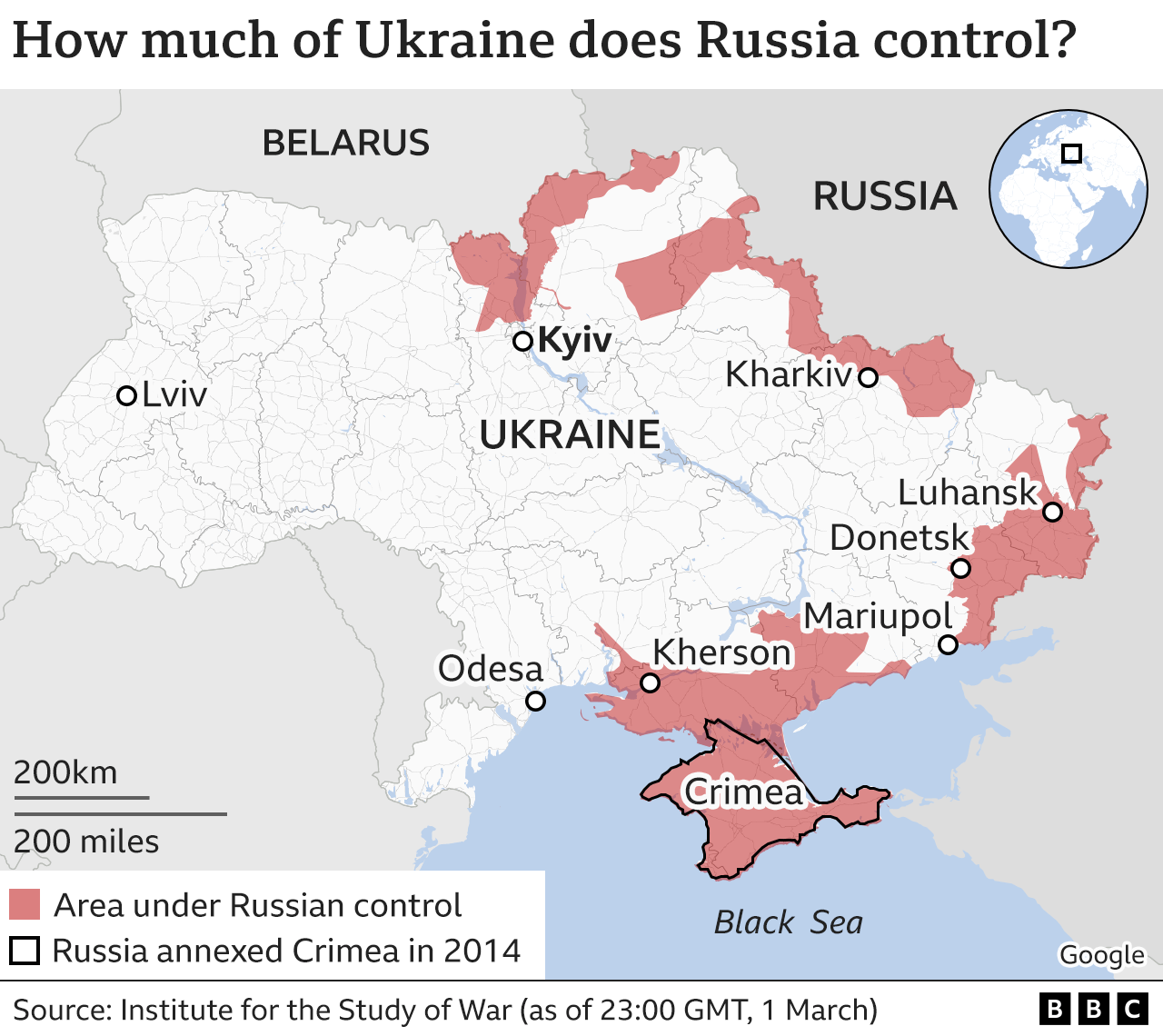
Immediately, airports and military headquarters were attacked, then tanks and troops rolled in from Russia, Russian-annexed Crimea and its ally Belarus. Now, warplanes have bombed major cities, and Russian forces have seized control of the key southern port city Kherson.
Russia refuses to use the terms war or even invasion; many of its leader's justifications for it were false or irrational.
He claimed his goal was to protect people subjected to bullying and genocide and aim for the "demilitarisation and de-Nazification" of Ukraine. There has been no genocide in Ukraine: it is a vibrant democracy, led by a president who is Jewish.
"How could I be a Nazi?" said Volodymyr Zelensky, who likened Russia's onslaught to Nazi Germany's invasion in World War Two. Ukraine's chief rabbi and the Auschwitz Memorial have also rejected Russia's slur.
President Putin has frequently accused Ukraine of being taken over by extremists, ever since its pro-Russian president, Viktor Yanukovych, was ousted in 2014 after months of protests against his rule.
Russia then retaliated by seizing the southern region of Crimea and triggering a rebellion in the east, backing separatists who have fought Ukrainian forces in a war that has claimed 14,000 lives.
Late in 2021, Russia began deploying big numbers of troops close to Ukraine's borders, while repeatedly denying it was going to attack. Then Mr Putin scrapped a 2015 peace deal for the east and recognised areas under rebel control as independent.
Russia has long resisted Ukraine's move towards the European Union and the West's defensive military alliance, Nato. Announcing Russia's invasion, he accused Nato of threatening "our historic future as a nation".
How far will Russia go?
It is now clear Russia is seeking to seize the big cities and overthrow Ukraine's democratically elected government. President Zelensky said he had been warned "the enemy has designated me as target number one; my family is target number two".
Russia's stated aim is that Ukraine be freed from oppression and "cleansed of the Nazis". Under this false narrative of a Ukraine run by fascists since 2014, Mr Putin has spoken of bringing to court "those who committed numerous bloody crimes against civilians".
His long-term ambitions for Ukraine are unknown. He denies seeking to occupy Ukraine and rejected a UK accusation in January that he was plotting to install a pro-Kremlin puppet. One unconfirmed intelligence report says he aims to split the country in two.
He faces stiff resistance from a deeply hostile population, but he has shown he is prepared to bomb civilian areas to fulfil his goals.
There is no immediate threat to Russia's Baltic neighbours, but Nato has bolstered their defences just in case.
Ahead of the invasion, Russia's public focus was always on the areas held by Russian-backed rebels in the east. But that changed when President Putin recognised their independence.
Not only did he make clear he saw them as no longer part of Ukraine, he revealed he backed their claims to far more Ukrainian territory. The self-styled people's republics cover little more than a third of the regions of Donetsk of Luhansk and the rebels covet the rest, too.
DOES ISLAM PROMOTE TERRORISM? The ‘ clash of civilizations ’ thesis has become fashionably outdated but still shapes the way we understand the connection between Islam, terrorism and the Middle East. In 2019, it is time to ‘forget the Middle East’ and change the way we perceive Islam. Vera Mironova, in ‘ The New Face of Terrorism ’, claims that the way Westerners think about ‘Islamist terrorism has grown dangerously outdated’, and the terrorist attacks at Western targets have been increasingly coming from militants of the former Soviet Union, not the Middle East. Following on these insights, I argue that it is time not only to ‘forget the Middle East’ but also stop essentializing Islam in the Middle East. For Mironova, the relative increase in anti-Western terrorist attacks emanating from the post-Soviet world is a result of several national, regional and international factors. On the one hand, with the rise of the Islamic State (ISIS), militants from Russi...
IUML leader Sayed Hyderali Shihab Thangal passes away Indian Union Muslim League (IUML) national chairman and Kerala State president Sayed Hyderali Shihab Thangal, 74, passed away on March 6. He died after fighting cancer for over a year. He was declared dead around 12.30 pm at Little Flower Hospital, Angamaly. Thangal’s condition had deteriorated the previous day and he was put on a ventilator. However, his younger brother Sayed Sadikali Shihab Thangal and IUML national general secretary P.K. Kunhalikutty had said that there was nothing to worry. Thangal’s death has brought a pall of gloom to Kerala’s Muslim community, over which he wielded considerable influence. He was widely respected by the people irrespective of their faith and political affiliation. Condolence messages started pouring in soon after the death was announced. The body will be taken to his house at Panakkad soon. His family said the funeral plans were on. Details were being worked out.
The Five Pillars are the core beliefs and practices of Islam: Profession of Faith ( shahada ). The belief that "There is no god but God, and Muhammad is the Messenger of God" is central to Islam. This phrase, written in Arabic, is often prominently featured in architecture and a range of objects, including the Qur'an , Islam's holy book of divine revelations. One becomes a Muslim by reciting this phrase with conviction. Prayer ( salat ). Muslims pray facing Mecca five times a day: at dawn, noon, mid-afternoon, sunset, and after dark. Prayer includes a recitation of the opening chapter ( sura ) of the Qur'an, and is sometimes performed on a small rug or mat used expressly for this purpose (see image 24 ). Muslims can pray individually at any location (fig. 1) or together in a mosque, where a leader in prayer ( imam ) guides the congregation. Men gather in the mosque for the noonday prayer on Friday; women are welcome but not obliged to participate. After ...


Comments
Post a Comment